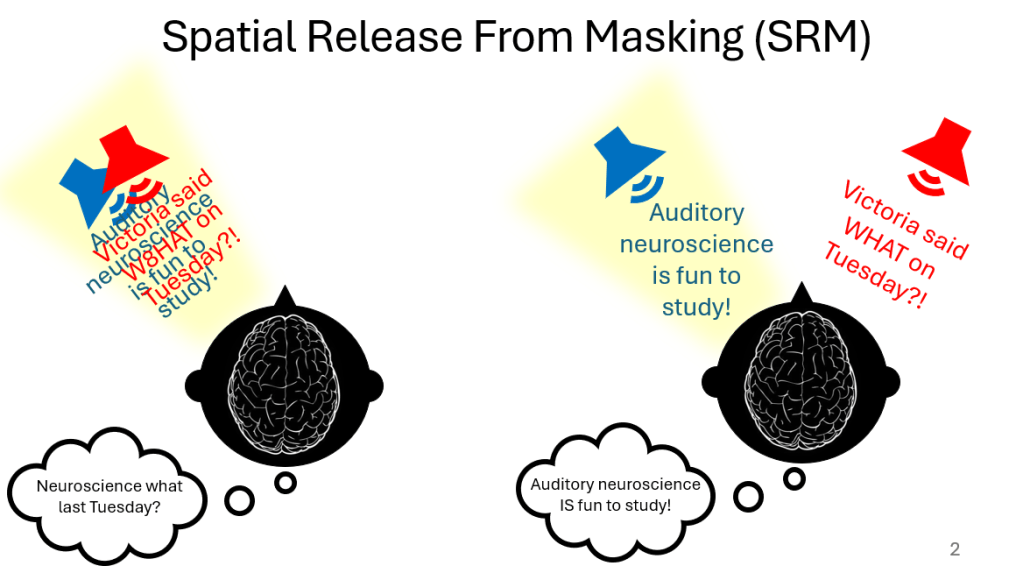
Spatial release from masking (SRM) is the benefit listeners receive in task performance when two sound sources are spatially separate, compared to when they are colocated. When information arriving at the two ears tells our brain that sounds are further apart, we can better attend to a target sound, and ignore a masker.
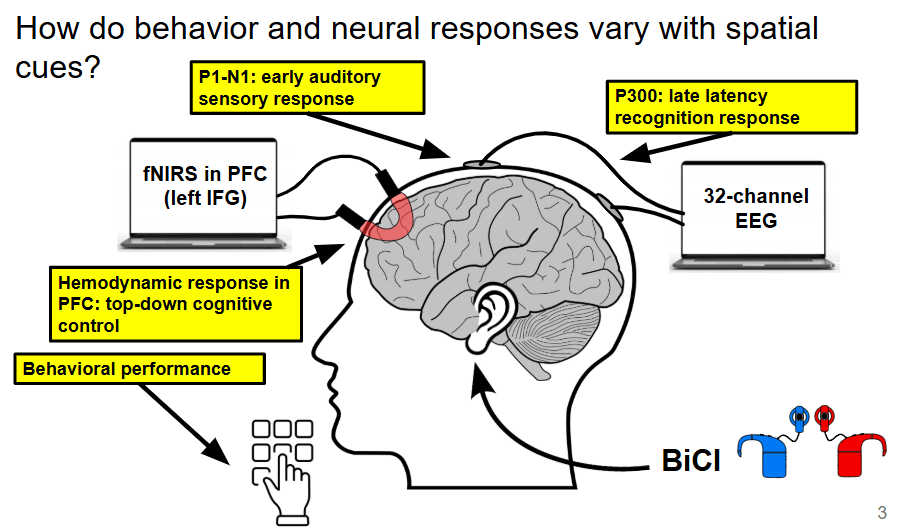
Here is a slide of our broad approach in recent experiments. We measure behavioral responses on selective auditory attention tasks, and non-invasively measure the brain using simultaneous electroencephalograpy (EEG) and functional near-infrared spectroscopy (fNIRS). How are prefrontal cortical and auditory sensory responses shaped by spatial auditory attention?
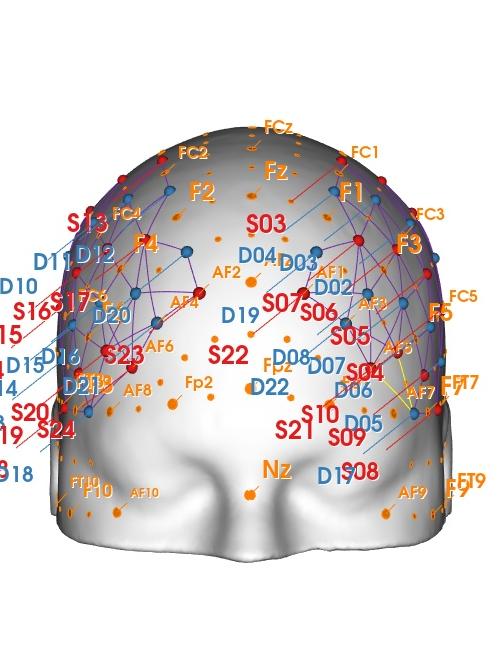
When we choose a brain area we would like to measure with fNIRS, we have to place light sensors to appropriately sense hemoglobin changes in that brain area. Here is an example of an fNIRS brain cap design that broadly covers the dorsolateral prefrontal cortex:
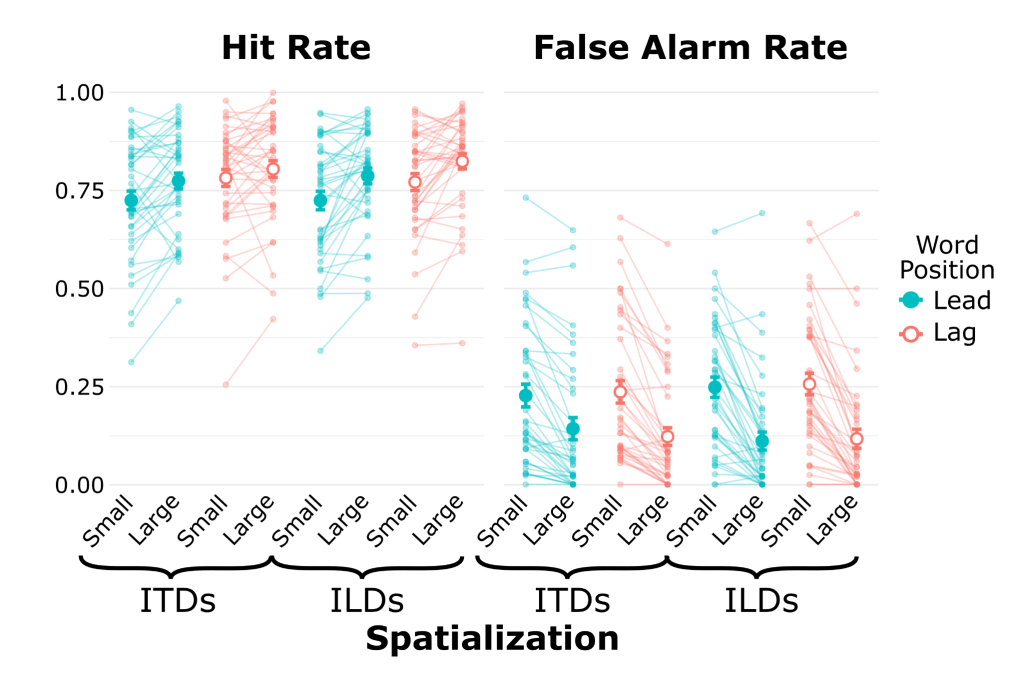
The brain has access to two spatial cues arising from the morphology of the head: the timing difference between the arrival of a sound wave at the two ears (interaural time differences, ITDs) and the difference in sound pressure level of the sound wave at the two ears (interaural level differences, ILDs). How do listeners use ITDs or ILDs alone?